An account of Yorkshire’s medieval trade links with the Baltic. They created a lasting network, not only for businesses and trade, but also for cross-cultural cooperation.
The story begins in former German city of Königsberg now called Kaliningrad and is part of the Russian Federation.
This is an intriguing account how Yorkshire’s medieval trade links with the Baltic created a lasting network, not only for businesses, but also for cross-cultural links.
The story begins in former German city of Kőnigsberg now called Kaliningrad in Russia.
The town was granted a charter in 1255 by the Teutonic Order, who conquered a fortified castle of the indigenous Prussians. From 1312 it was the most important military base of the Order. From 1331 – 1394 English knights fought alongside the Order in the Northern Crusades. After the treaty of Krakow in 1525, Kőnigsberg became the capital city of the secular dukedom of Prussia (later called East-Prussia – a province of the Kingdom of Prussia).
It was an important port and member of the Hanseatic League with a large diverse merchant community, which included English wholesalers as well as Scottish retail traders. There is frequent mention of many English citizens from the East coast including King’s Lynn, Norwich, Hull, York and Beverley among others. Many merchants took their families and settled in towns within the territory governed by the Order. Trading had its origins in the large-scale production of English cloth in the middle of the 14th century. It continued after the Hanseatic League lost its Baltic hegemony to Dutch and English merchants in the 17th and 18th century.
Albertina, the university of Kőnigsberg (now called Kant University) was founded in 1544 by Duke Albert of Brandenburg, who left his position as grandmaster of the Teutonic Order and converted to Lutheranism. As the first Protestant university,
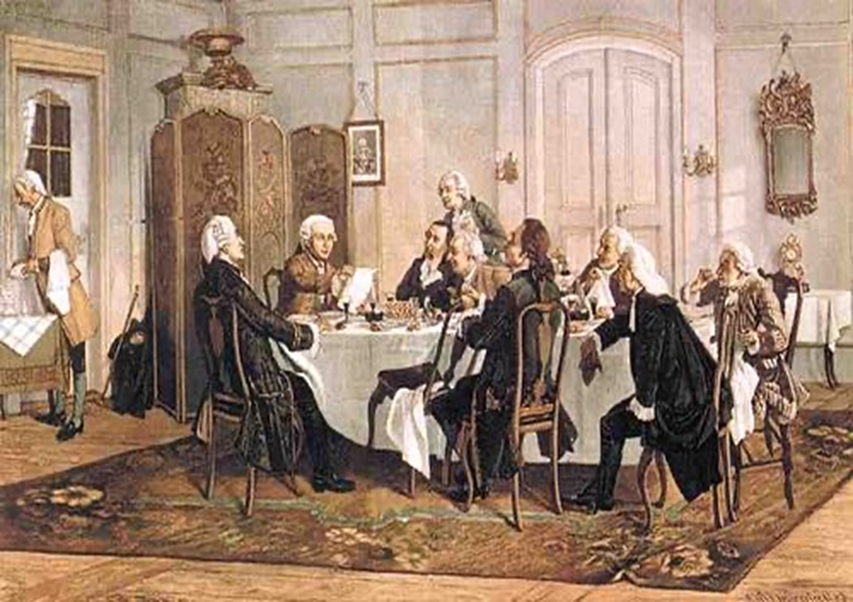
Kant with friends
quickly became a focus for liberal and forward-thinking academics. During the 18th century, its most famous professor was the philosopher Immanuel Kant.
Immanuel Kant (1724 – 1804) was born in Kőnigsberg, son of a harness maker. He never married and rarely left his hometown. As a professor of philosophy, he became one of the central Enlightenment thinkers. His ground-breaking work and writings have made him one of the most influential figures in modern Western philosophy.
He was sociable and likeable and chose his friends from people, who could increase his knowledge of the world and awareness. He particularly enjoyed the company of wealthy merchants including English and French business people. One of them was the very wealthy grain merchant Jean Claude Toussaint (married Catherine Fraissinet from Kőnigsberg) a Huguenot from Magdeburg.
Kant and his friends
Joseph Green (1727-27th June 1786) was born in Hull and settled in Kőnigsberg. He traded in grains, coal, herring and manufactured goods. He never married.
Around 1764 Green met Kant and became a close member of his circle of friends and his best friend. Kant often went to Green’s house, which was built in English style in a leafy suburb. Green and Kant shared a deep appreciation of the ideas of David Hume and Jean-Jacques Rousseau. In addition, Green could provide a perspective on the outside world that was helpful to Kant.
Meeting on a regular basis, Kant discussed his work with him, including every sentence of his most famous work ‘Critique of Pure Reason’. Kant also entrusted Green with his money. As a professor and later director of the university, his salary was rather modest. Green invested Kant’s savings wisely and made him a wealthy man.
Green’s sense of order and resulting pedantic punctuality inspired one of the friends, Theodor Gottlieb von Hippel to write the comedy: ‘Der Mann nach der Uhr’. (The Pedantic Timekeeper). Green was highly educated and an excellent scholar of the works of David Hume.
After Green’s death in 1786, Kant was so deeply affected, that he gave up his evening dinners with friends.
Robert Motherby,
A long-time friend of Immanuel Kant, Motherby was born on 23rd Dec. 1736 in Hull. He had four brothers and three sisters. His father George (b. 20th Dec. 1688) married Anne Hotham (died 1748). Robert probably arrived in Kőnigsberg around 1751 when he was 18 years of age. Through a joint contact in Hull, he was recruited as a young man by Joseph Green, initially as an assistant. Although he spoke little German, he settled easily and became a business partner and eventually took over the firm Green, Motherby & Co. In 1762 he married Charlotte Toussaint. They had 11 children. One of them was William Motherby, who went on to become a doctor and expert in agriculture in Berlin. Kant always joined the family for Sunday lunch and played and joked with the children.
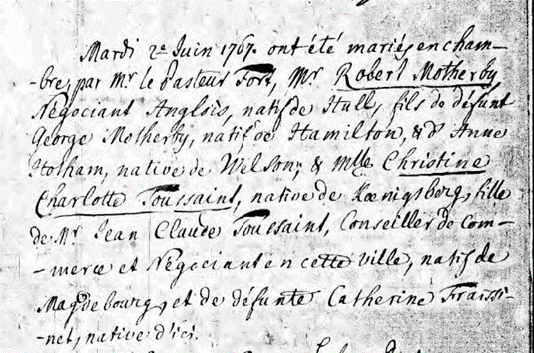
Marriage certificate of Robert Motherby and Charlotte Toussaint from the Huguenot Church, which clearly states, that he is from Hull. (Added by Bill Longbone, Friends of Hull General Cemetery)
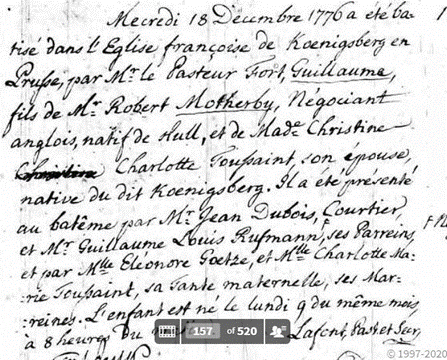
Christening certificate of William Motherby, Robert’s first-born son. (Added by Bill Longbone, Friends of Hull General Cemetery)

A postcard with the image of the Calvinist church, where these ceremonies took place. It was destroyed in WWII. The British Air Force carried out two bombing raids in Aug 26th/27th and 29th/30th 1944.
The town Council named a street in Kőnigsberg, Motherby Strasse. The name was changed by The Soviet government after 1945.
Society of Kant’s Friends (see www.freunde-kants.com)
Immediately after Kant’s death, his friends began to commemorate his birthday on 22nd April with a meal. In 1844, this annual event led to the formation of the ‘Society of Kant’s Friends’.After each meal, they took it in turns to give a talk.
Traditional has it that cake is eaten for dessert. Whoever finds a bean in their piece, takes the role of ‘Bean King’ (an honoury title) for a year. In 2016 Marianne Motherby became Bean Queen. She and her brother John Motherby organise the Kant meals on the 22nd April, to this day in Kaliningrad.
Eva La Pensée January 2021







 Clive La Pensée